
FF
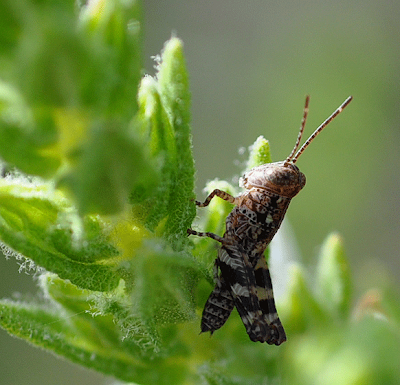
When I first saw a picture of Leichhardt’s Grasshopper I was amazed that any insect could look that impressive and especially one that lived so close to me. But as I tried to find any information about the grasshopper it became obvious that Leichhardt’s Grasshopper was going to be difficult if not impossible to find. So I guess I became obsessed with finding it. Well its taken three trips to Kakadu, but I finally managed to see the grasshopper. I saw nothing the first trip, just the lay of the land. The second trip I located the sole plant on which it lives, but no grasshoppers. On the third trip, when I finally started seeing grasshoppers on the Pityrodia jamesii it was confusing because they were very small and did not look like the beast I expected. On the afteroon I arrived, the scent of the aromatic Pityrodia jamesii was very strong and hanging on every breeze, the humidity had dropped as it was late in the day and it was obvious the plant attracted a wide variety of guests. However, I examined many Pityrodia jamesii shrubs but without any luck. Because the plant was flowering, it was easier to see and I even located more shrubs among the rocky scarps, but no big grasshopper. I came back the next day to find the small grasshoppers exactly where I had photographed them the previous afternoon. I thoroughly checked every Pityrodia jamesi shrub in the vicinity, even finding several I had not found the previous day, but no big fella. I walked down to a small babbling creek and was resigned to going back empty handed. But as I worked my way back towards the road re-checking previously checked shrubs, I noticed a very small Pityrodia jamesi growing amongst some broken slabs of sandstone pediment. On one of the stems there was a very large and darkish figure, and to my joy, a full grown Leichhardt’s Grasshopper. I am not sure wether I yelled for joy or just release but the moment was intense. As the adrenalin wore off I was amazed at just how much fauna was related to the flowering of this and other flowering plants in the area.
FF
According to Aboriginal thinking “At this time of year, Leichhardt's grasshopper is said to be out and about looking for the lightning in its new gaudy outfit. Namarrgon is commonly depicted in the regions rock art with axes hanging from his body, which he uses to strike the clouds. Around Kakadu the axes on his head represent grasshopper's antennae.” Source: Gaudy grasshopper brings on the wet By Janet Parker
FF
Namarrgon The Lightning Man
FF
When I first saw a picture of Leichhardt’s Grasshopper I was amazed that any insect could look that impressive and especially one that lived so close to me. But as I tried to find any information about the grasshopper it became obvious that Leichhardt’s Grasshopper was going to be difficult if not impossible to find. So I guess I became obsessed with finding it. Well its taken three trips to Kakadu, but I finally managed to see the grasshopper. I saw nothing the first trip, just the lay of the land. The second trip I located the sole plant on which it lives, but no grasshoppers. On the third trip, when I finally started seeing grasshoppers on the Pityrodia jamesii it was confusing because they were very small and did not look like the beast I expected. On the afteroon I arrived, the scent of the aromatic Pityrodia jamesii was very strong and hanging on every breeze, the humidity had dropped as it was late in the day and it was obvious the plant attracted a wide variety of guests. However, I examined many Pityrodia jamesii shrubs but without any luck. Because the plant was flowering, it was easier to see and I even located more shrubs among the rocky scarps, but no big grasshopper. I came back the next day to find the small grasshoppers exactly where I had photographed them the previous afternoon. I thoroughly checked every Pityrodia jamesi shrub in the vicinity, even finding several I had not found the previous day, but no big fella. I walked down to a small babbling creek and was resigned to going back empty handed. But as I worked my way back towards the road re-checking previously checked shrubs, I noticed a very small Pityrodia jamesi growing amongst some broken slabs of sandstone pediment. On one of the stems there was a very large and darkish figure, and to my joy, a full grown Leichhardt’s Grasshopper. I am not sure wether I yelled for joy or just release but the moment was intense. As the adrenalin wore off I was amazed at just how much fauna was related to the flowering of this and other flowering plants in the area.
FF
According to Aboriginal thinking “At this time of year, Leichhardt's grasshopper is said to be out and about looking for the lightning in its new gaudy outfit. Namarrgon is commonly depicted in the regions rock art with axes hanging from his body, which he uses to strike the clouds. Around Kakadu the axes on his head represent grasshopper's antennae.” Source: Gaudy grasshopper brings on the wet By Janet Parker
FF
Namarrgon The Lightning Man
FF

FF
Lesser Wanderer Danaus chrysippus
FF
 FF
FFCommon Crow Euploea core
FF
 FF
FFGrevillea dryandri ssp. Dasycarpa
FF
 FF
FFHaemodorum coccineum
FF
 FF
FFUnidentified Leaf Beetle Family Chrysomelidae
FF
 FF
FFLeichhardt's Grasshopper Petasida ephippigera White
FF
 FF
FFLeichhardt's Grasshopper Petasida ephippigera White
FF
 FF
FFMinyacris nana (SjÖstedt)
FF
 FF
FFPerbellia picta SjÖstedt
FF
 FF
FFUngee-gungee, Desertaria lepida (Walker)
FF
 FF
FFAsteromyrtus magnifica
FF
 FF
FFMelelueca symphyocarpa
FF
 FF
FFSilver-crowned Friarbird Philemon argenticeps
FF
 FF
FFUnidentified Leaf Beetle Family Chrysomelidae
FF
 FF
FFYellow Lynx Spider Oxyopes variabilis
FF
 FF
FF


