Friday, June 17, 2011

SANDSTONE COUNTRY IV / June 2011 / Part II

Baroalba Creek is the main drainage for Mount Brockman, a large, irregularly shaped massif sitting on the plains a few kilometres away from the edge of the Arnhem escarpment. Its maximum dimensions are about 11 kilometres east to west and 15 kilometres north to south. Its maximum height is about 300 metres above sea level, about 240 metres above the surrounding plain. While the edges of the massif are extremely rugged and steep, much of the centre consists of a large basin drained by Baroalba Creek. The rugged nature of the approaches prevented buffalo from reaching the basin, making this one of the few undisturbed areas in Kakadu. The area is full of rock shelters that were used by Aboriginal people over the millennia. It contains what may well be the greatest concentration of Aboriginal rock art in Australia, dating from the most ancient to the most recent.

Masked Cave-Frog Litoria personata At Home
Masked Cave-Frog Litoria personata CloseUp
Morning Mist South Alligator Flood Plain SunUp
Native Grass Themeda triandra Motor Car Falls
Neon Cuckoo Bee - Thyreus nitidulus
Nomia Bee HALICTIDAE sp.
Orange Lacewing Cethosia penthesilea Motor Car Falls
Orb or Wheel Weaving Spider Argiope sp. Motor Car Falls
Osbeckia australiana
Painted Grasshawk Neurothemis stigmatizans stigmatizans
Petalostigma quadriloculare F.Muell. var. genuina
Planthopper Fulgoroidea sp. Motor Car Falls
Polygala longiflora Motor Car Falls
Praying Mantid Hierodula sp. Nymph Close Up Robyn Falls
Praying Mantid Hierodula sp. Nymph Robyn Falls
Pterocaulon serrulatum Motor Car Falls
Purple Oak-blue Arhopala centaurus Robyn Falls Sandstone Country
Robyn Falls Sandstone Country
Sandstone Escarpment Baroalba Springs Deep Undergrowth
Sandstone Escarpment Baroalba Springs Valley
Small Blue Leaf Beetle - Nisotra breweri With
Possible Astigmatid Mite Feeding On The Beetle
Spermacoce calliantha Sandstone Country
Stretch spider Tetragnathidae sp.
Top End Archtail Nannophlebia mudginberri
Trap-jaw Ant Odontomachus turneri
Tree Orchid Dendrobium dicuphum Motor Car Falls
Triumfetta sp. Motor Car Falls
Tropical Gumleaf Grasshopper Goniaea furcifera Female Robyn Falls
Turkey Bush Caltrix exstipulata
Wedge-tailed Eagle Aquila audax Roadside Kill
South of Adelaide River Township Stuart Highway

Friday, June 3, 2011

Dhaarratharramirri Season in Darwin


Late April, May, June, July, August South-east or dry season. Wind in east and south-east People nomadic; big wet-season camps breaking up. Systematic burning of all extensive grassed areas, communal drives for kangaroo, bandicoots, goanna. Fishing still important, with nets, grass barriers, in shallow waters on plains & salt pans.

The Yolngu have at least 11 plants that act as calendar plants. These are plants that act as conspicuous indicators of certain seasonal occurances that are important but difficult to observe. Generally calendar plants have distinctive flowers that indicate an animal food resource is at it's best and should be hunted or collected. Due to the variability of seasonal weather patterns, it is important to have recognised indicators of food resources available, so that the hunting period is optimal.*

Dharranggulk (Yolngu name) – Red Flowering Kurrajong – Brachychiton paradoxus: A small deciduous tree with large leaves and red flowers that grows in open forests and woodlands. The flowering of this species signals that baby sharks are ready to be hunted (they are considered a delicacy and are much sought after), that scrub fowls have laid their eggs and the eggs may be dug out of nests, and that mud crabs contain eggs, which are the same colour as the Dharrangnulk flower.

[*reference: 'Rirratjingu Ethnobotony: Aboriginal Plant Use From Yirrkala, Arnhem Land, Australia']

Right Now the Dharranggulk are in full bloom.

Aiteta iridias Adult Moth
Aiteta iridias Cocoon
Aiteta iridias Larvae
Ant Lion MYRMELEONTIDAE sp.
Asota orbona Moth
Bothriochloa bladhii subsp. bladhii
Brown Leafhopper - Alotartessus iambe Tended By Ant Papyrius sp.
Calomyrmex impavidus Ant Attending Aphid Aphis nerii.Feeding on Red Natal Grass Melinis repens
Calomyrmex impavidus Ant
Chalcidoid Wasp CHALCIDOIDEA sp. Unidentified Larval Leaf Galls
Grass Chloris barbata
Crotalaria goreensis Seed Pod
Grass Themeda triandra
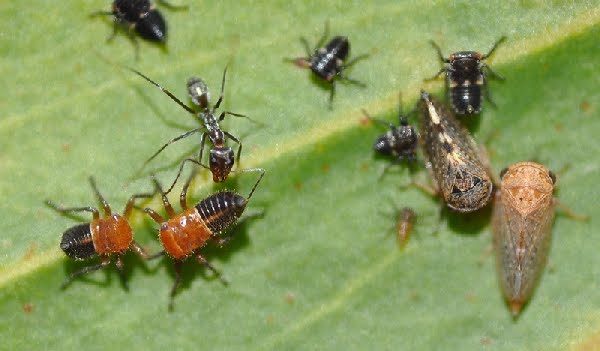
Gum-treehopper Eurymelinae sp. Nymphs
Gum-treehopper Eurymelinae sp.
Hawk Moth Possibly Macroglossum corythus or M.hirundo Cocoon Thanks To Jim Tuttle For Identification Help
Hawk Moth Possibly Macroglossum corythus or M.hirundo Larvae Thanks To Jim Tuttle For Identification Help
HYMENOPTERA sp. Feeding On Pennisetum polystachion
Jewel Spinned Spider Austracantha sp.Spinneret
Ladybird Beetle - COCCINELLIDAE sp.
Monkey Grasshopper EUMASTACIDAE sp.
Paddy Bug - Leptocorisa acuta
Red Natal Grass Melinis repens
Thanatodicta sp.
Traminda aventiaria Larvae
Traminda aventiaria Adult Moth Green Variation
Traminda aventiaria Cocoon. Suspended between Container Roof and Bottom Leaf
Traminda aventiaria Adult Moth Brown Variation

Thursday, June 2, 2011

Remnant Vine Forest I May 2011

Monsoon vine-forests in the Top End of the N.T. occur in a variety of habitats, from situations favoured by year-round moisture availability, to sites where moisture is seasonally scarce. They also occur on a broad range of rock and soil types. As might be expected monsoon vine-forest vegetation is thus structurally very variable, ranging from tall evergreen forests over 30m in height, to deciduous thickets often only 2-3m in height on particularly harsh dry sites.

Evergreen vine-forests are associated with rare perennial spring and seepage habitats, as well as along the margins of some perennial streams. Good examples in the Darwin region include Holmes Jungle, Berry Springs, Howard Springs and Black Jungle. In these situations soils are typically waterlogged with relatively deep organic loams overlaying grey clays. Under optimal conditions canopy height is seldom greater than 25m, the upper canopy dominated by evergreen trees.

Coastal vine-forests
Coastal vine-forests occur on a variety of mainly seasonally dry substrates, especially sandy or shelly beach ridges (e.g. parts of Casuarina Beach, Darwin), and lateritic landforms (e.g. East Point Reserve, Darwin). As with other types of vine-forest vegetation tolerant of seasonal dryness, coastal vine-forests show no particular requirement for deep soils as on substrates which offer no impediment to deep root development. The canopy of coastal vine-forests is typically less than 10m in height, although individual emergent trees, especially deciduous trees may attain heights of 16m or more.


Acacia hemignosta


Aloa marginata Thanks to Don Herbison-Evans For Identification Help


Australian Magpie-lark Grallina cyanoleuca


Black-headed Skimmer Crocothemis nigrifrons


Blue-banded Eggfly Hypolimnas alimena ssp. lamina Form B


Chocolate Argus Junonia hedonia


Common Crow Euploea core Feeding On Buchnera sp.


Common Glider Tramea loewii


Jumping Spider Hypoblemum albovittatum


Kurrajong Brachychiton paradoxum


Leaf Beetle Phyllocharis sp. And Eggs


Lindernia lobelioides


Long-jawed Spider Tetragnatha sp. Newly Hatched Spiderlings


Masked Lapwing Vanellus miles


Pied Butcherbird Cracticus nigrogularis


Swamp Tiger Danus affinis


Terminalia microcarpa


Tortoise Beetle Cassidinae sp.


Utricularia leptoplectra


Wandering Pennant Macrodiplax cora Female